
Find Braintree Residents by Record
There is no unrestricted master list of Braintree residents. The useful trail depends on whether the starting point is a present address, a name, or a past household. The Town Clerk's annual Resident Street Listing Book is a dated census-related snapshot. The Assessors portal identifies a parcel owner and its physical record. The Norfolk Registry connects parties to recorded land instruments. Thayer Public Library and the State Library preserve older directory and town-report material. Each source has a different purpose, so a result should be read as evidence for that source, not as a full profile of a person.
Begin with the narrowest fact already known. A street and number usually belong first in the assessor search. A historic name may belong in a directory or newspaper. An event may require a vital-record request. A match becomes stronger when two independent details agree, such as an address and occupation, or a parcel and deed reference. Current owners, occupants, tax mailing addresses, and people printed in an old volume are different categories. Keeping those labels separate avoids a common and consequential error.
- Search a current street or owner in Braintree Assessors / Patriot Properties and record the parcel identifier and situs address.
- Check the Norfolk Registry only after noting the owner, town, and any book/page clue. Compare party role and document date before accepting a name match.
- For a historical household, use the relevant directory year, printed street list, newspapers, and town reports held through Thayer Public Library.
- Ask the specific custodian for a non-searchable record. Massachusetts public-records requests can be written by letter, fax, email, or in person without a required form.
Note: A resident listing, parcel result, or old directory entry is a dated lead, not proof of current occupancy or ownership.
Braintree Resident Records Desks
Braintree records are held by the office that made them. The Town Clerk is the chief election official and chief records officer, with annual census material, vital records, business certificates, licenses, and town books. The Assessors maintain taxable parcel records. The Norfolk County Registry of Deeds in Dedham records deeds and other land documents. Court files remain with the relevant clerk or register, not with one countywide people-search portal. These offices provide related, but not interchangeable, views of Braintree residents and properties.
Norfolk County Registry of Deeds
649 High Street
Dedham, MA 02026
781-461-6101
Braintree Assessors
1 JFK Memorial Drive
Braintree, MA 02184
See Town Hall access details
Braintree Town Clerk
1 JFK Memorial Drive
Braintree, MA 02184
781-794-8240
Street-by-street parcel research brings the assessor, GIS, and deed trail into one address-focused workflow. Confirm office hours before visiting. The Registry lists weekday counter hours of 8:30 to 4:30, while Town Hall department hours vary by day.
Braintree Parcel Records for Residents
The Patriot Properties assessor form is the current property starting point. It can search by parcel, owner, street name and number, building type, lot size, value, sale date or price, year built, finished size, beds, baths, neighborhood code, land-use code, and book/page. The form has no ZIP-code field. Use a street number and street name for an address question, or an owner name for an ownership question. Save the physical situs address apart from a mailing address shown in a result.
The Braintree Patriot Properties search form shows the parcel, owner, street, value, sale, and book/page routes available before a result is opened.
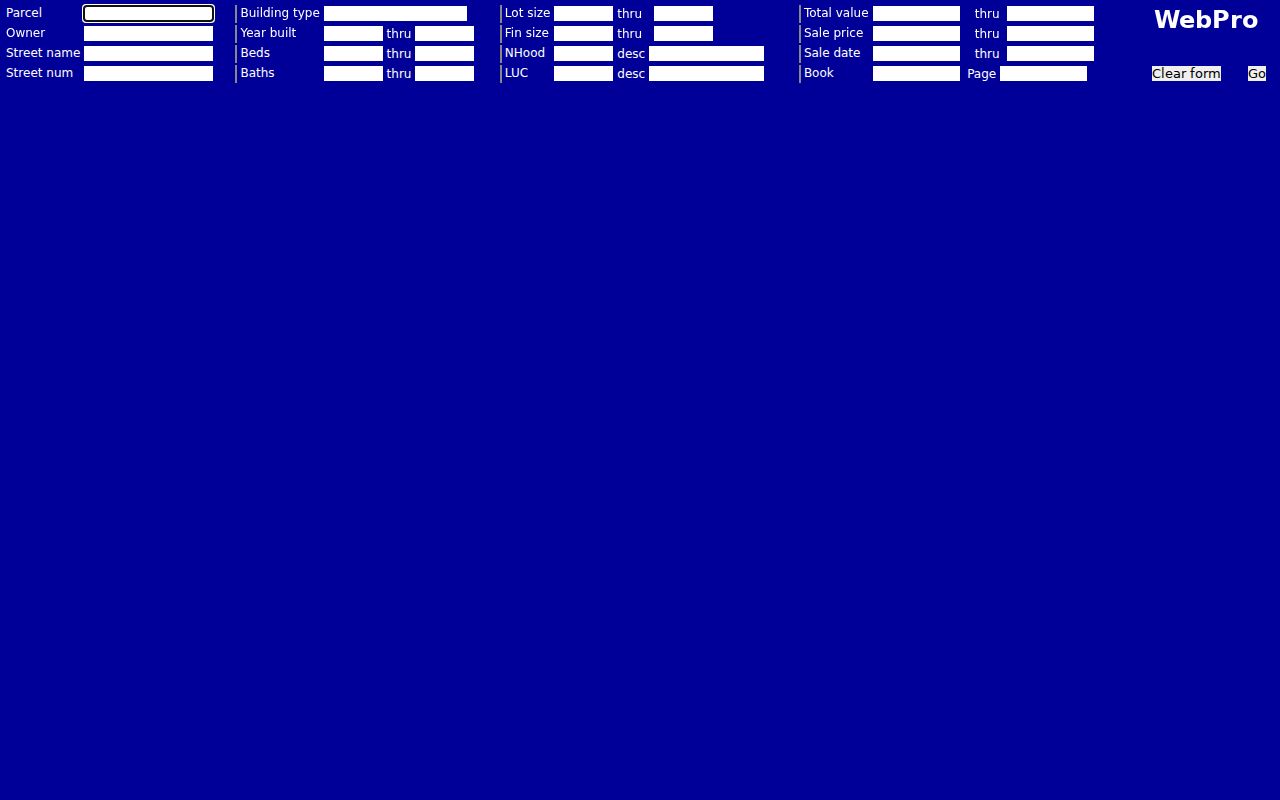
Those fields make the assessor record a strong parcel lead, but not a roster of everyone at an address. A trust, corporation, estate, or absentee owner can appear as owner of record. The municipal GIS can then locate the parcel, while the Registry establishes the recorded title trail. Assessment details change over time, so record the search date as well as the assessment year.
| Patriot search field | Use in a Braintree parcel search |
|---|---|
| Owner | Find an assessed owner, then check whether the record shows a distinct mailing address. |
| Street name and number | Start an address search with the two fields together when both are known. |
| Parcel or book/page | Use a recorded property reference to narrow a result or connect it to Registry research. |
| Sale date or price | Set a range when a dated transfer is the question, then verify the land instrument. |
| Neighborhood or LUC code | Apply a municipal classification filter, not a claim about a household. |
- Parcel
- A mapped unit used for assessment and property administration.
- Situs address
- The physical location of the parcel, which can differ from a tax mailing address.
- Book/page
- A Registry reference that can help connect an assessor record to a land document.
Braintree's Annual Street Listing Book
The Town Clerk describes the annual Resident Street Listing Book as the town's census-related street source. Updated books are published each August and copies are sold during the year. That gives Braintree residents research a local, dated street layer that is different from an ownership index and different from the Secretary's individual voter tool. Ask the Clerk about the year needed and whether the volume can be viewed or purchased. The complete historic run and online access details were not cataloged in the research, so they should not be assumed.
The annual census process also explains why timing matters. The town sends a census and registration confirmation to the head of household each January. A nonresponse can affect active voter status, according to the Town Clerk's voter information. A street-list entry therefore captures an administrative cycle. It does not prove title, citizenship, voting eligibility, or continuous occupancy. For a past address, pair the right annual book with a directory, parcel record, deed, or town report from the same period.
Current Braintree Resident Sources
Current Braintree residents appear in narrow official systems, not in one public directory. The table distinguishes what each source can support. A parcel owner may not live at the property. The state voter service is designed for individual status checking with supplied identity information, not neighborhood browsing. A recorded deed names parties to a land transaction. A Town Clerk street book has a specific annual date. When the goal is to verify one person across records, the Braintree resident lookup gives the more focused sequence.
| Source | Who It Lists | Keeper | Access |
|---|---|---|---|
| Patriot assessor record | Owner of record and parcel details | Braintree Assessors | Free current portal |
| Resident Street Listing Book | Names listed for a particular annual cycle | Braintree Town Clerk | Ask about the volume and access |
| Massachusetts voter status tool | Individual registration-status result | Secretary of the Commonwealth | Free, name/DOB/ZIP input |
| Norfolk land index | Recorded-land parties and document references | Norfolk Registry of Deeds | Free index and images |
| Town Resource Directory | Community organizations and institutions | Town of Braintree | Free organization directory |
For an organization or civic connection, the Town Resource Directory searches categories and names but does not publish a household roster. For a historic person, Thayer directories, newspapers, yearbooks, and town reports often offer a better dated lead than any present-day system. Each result needs its source URL, access date, and a statement of what the source actually establishes.
Braintree Voter Status Has Limits
The Massachusetts individual voter-status lookup asks for first name, last name, month, day and year of birth, a five-digit residential ZIP code, and agreement to the page statement. It is intended to let an individual check registration status. Search tips advise using the registered name, trying an old ZIP after a move, and allowing two to three weeks for a recent registration to appear. The ZIP is a required input, not a way to retrieve a list of Braintree residents.
The official form demonstrates the individual fields and agreement step used by the Massachusetts voter lookup.
M.G.L. c. 51, § 47C limits general release of name and address data in the central voter registry. Braintree's public-facing alternative for dated street history is the Town Clerk's Resident Street Listing Book. Polling places and precinct information describe civic geography, not who is registered or how anyone voted.
Norfolk Deeds for Braintree Residents
The Norfolk land-records search is a name and town index, not an ordinary address directory. Choose Braintree, search a likely last and first name, and compare the grantor or grantee role, document type, date, and reference. The Registry's guide recommends wildcard searching for spelling variants and a separate Land Court path when the expected record is not in the Recorded Land result.
To work backward from a house, begin with the assessor's current parcel and owner. Then search the owner as a grantee, open likely deed images, and follow the prior deed reference. Address indexing is limited for documents before 2003, so older research may need a legal description, historic map, Registry staff assistance, or earlier deed books. The images are free research leads but are marked “Not An Official Copy.” The Registry is the source for certified or office copies; its published in-person copy price is $1 per page.
Note: A deed identifies a recorded land interest, so it should never be used alone to label every person at the property as a resident.
Braintree Court and Vital Routes
MassCourts is the state route for public dockets. It has Name, Case Type, Case Number, and Ticket/Citation search modes, with department, division, location, and result-count selectors. Name searching is civil-oriented, and an online docket may not be the complete official file. Retain the court department and location with any case number, then contact the Clerk or Register for a certified document or an online-correction question. A name match alone does not establish identity, responsibility, or a Braintree address.
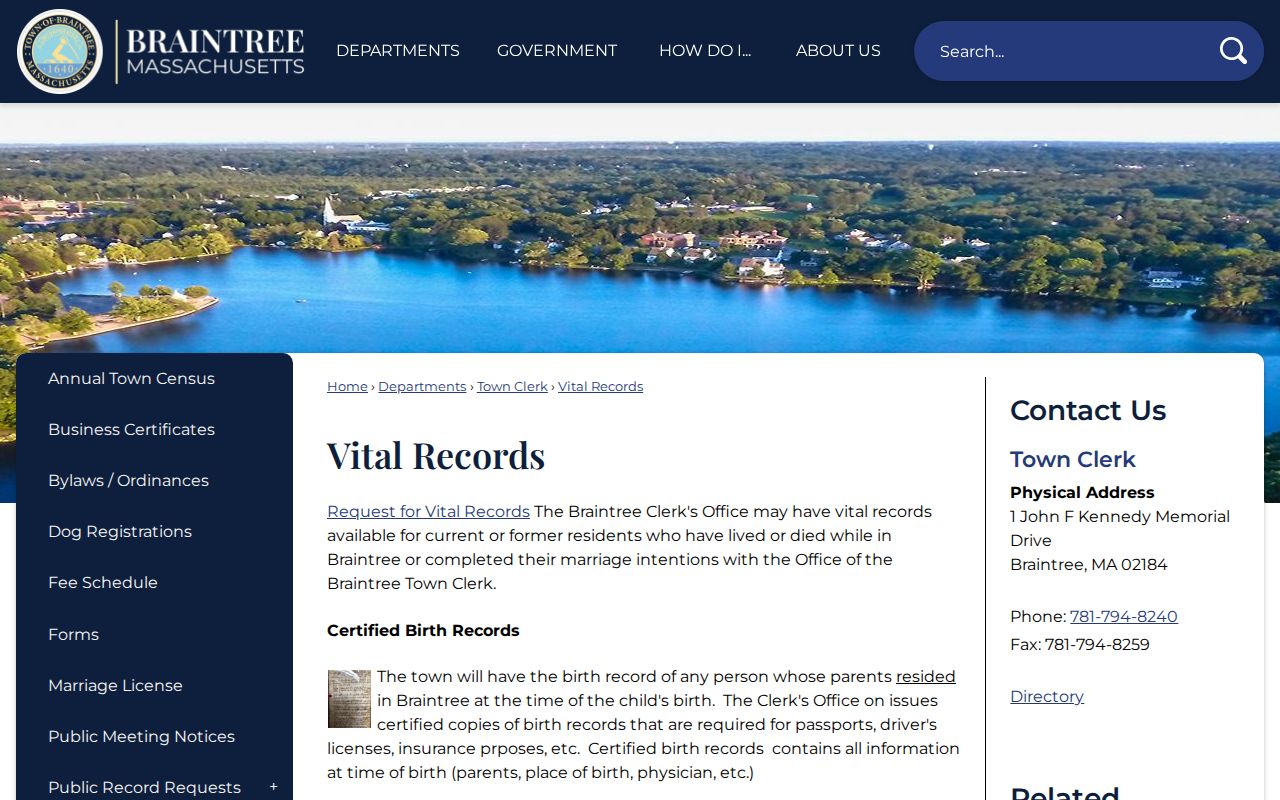
For a family event, Braintree Vital Records has a local route. The town states that it holds records from 1640 forward and lists $12 certified copies, subject to category-specific eligibility. It can hold a birth record when parents lived in Braintree, a marriage record when intentions were filed there, and a death record when the person died in Braintree or was a Braintree resident at death. Online, mail, and in-person channels are available; restricted records require the proper relationship and documentation.
The official Braintree vital-record page explains local eligibility, ordering choices, fees, and restricted-record notice.
State research divides the holdings by period: RVRS maintains 1936 to the present, 1931 to 1935 is at the State Archives, and older city or town copies can be local. Birth and marriage records more than 90 years old, and death records more than 50 years old, generally fall within the statutory historical exception, subject to the custodian's current implementation.
The Massachusetts genealogy guide shows the State Archives and RVRS date split and its on-site research-room limits.
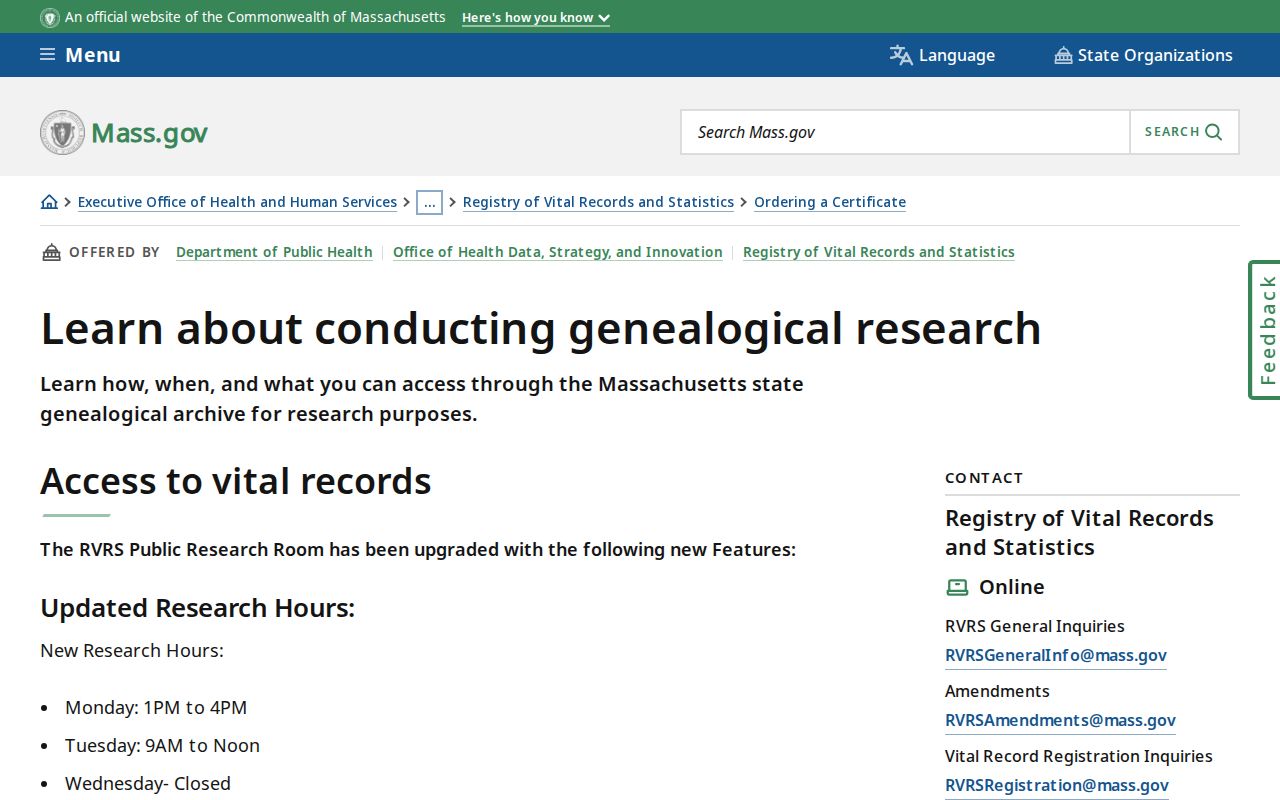
The state research room is an access route rather than a general online name index. Use the local Town Clerk route when Braintree's jurisdiction rule applies, and the state ordering route when the date and record type point there.
Historical Braintree Resident Directories
Braintree's historical resident trail is spread across State Library holdings, Thayer collections, the Historical Society, directories, town reports, newspapers, maps, cemetery sources, probate, and land records. The State Library lists Braintree directory years from 1870 through 1943 with gaps. Thayer provides Braintree directories for 1916 through 1935 and digitized town reports from 1640 through 2006. Printed entries can show a name, occupation, workplace clue, spouse notation, street, village label, or house and boarding abbreviation. They do not automatically identify a modern parcel or prove a continuous household.
The 1896 J. H. Hogan volume and the 1916–17 Union Publishing directory both need careful reading because they are regional. Their Braintree material can use B., S.B., E.B., P.O., Weymouth, or Quincy labels. A separate cataloged Braintree reverse directory was not located. For a street-first question, use the printed street list as a reverse-like entry point, then cross-reference the alphabetical section. The Braintree city directory collections provide the full shelf, date, and abbreviation workflow.
Braintree Newspapers and Town Reports
Thayer Public Library gives Braintree's directory material useful companions. Its genealogy resources describe newspapers dating back to 1881, yearbooks from 1935 through 2016, and town reports from 1640 through 2006. Remote newspaper access is described for publication dates through 1966; later local material through December 31, 2020 is a library-access route. The difference matters. A researcher should not promise a remote search for a period the library reserves for on-site access.
Town reports can place a person in a public role, an appointment, a committee, or an older vital-record appendix. Yearbooks can confirm a school cohort. Newspaper items can supply a date, relationship, or organization lead. None should stand alone when a conclusion depends on identity. Match at least two details beyond a surname, such as a spouse and occupation or a street and civic role. For obituaries, no dedicated online Braintree index was confirmed in the research. Thayer newspaper databases are the official local-history direction, with a death certificate, cemetery record, probate file, or town report used for confirmation.
Note: A regional directory or newspaper item can use a neighboring-town or village label, so retain the printed wording and page reference.
Braintree Records Survived the 1911 Fire
A Braintree records story explains why local history has several strong access paths. A Massachusetts Archives report says a July 20, 1911 fire largely destroyed Town Hall, but no records were lost. That continuity is valuable, although it does not mean every surviving document sits in the same office or is online. Early town records, later town reports, historical maps, county books, and library copies may now live in different repositories.
Braintree was incorporated in 1640, while Quincy separated in 1792, Randolph in 1793, and Holbrook in 1872. An older “Braintree” reference can therefore point to territory outside the present town. Test the historical jurisdiction before treating a record as missing. The 1886 Bates edition of Braintree Records, 1640–1793, Thayer's digitized town reports, and Historical Society map and file holdings are practical ways to place a name or property in its correct period.
Braintree License and Business Records
Some resident questions concern a public role rather than a home address. Massachusetts eLIPSE searches individual and business licenses by first, middle, and last name, city, state, ZIP, board, license type, or license number. The Corporations Division has separate entity, officer-name, identification-number, and filing-number searches. Braintree's Town Clerk and municipal licensing offices maintain local business-certificate and license routes. These are filings and status records. They can document an official business or license connection, but not a person's current residence.
The Massachusetts eLIPSE page presents the Individual and Business search tabs along with geographic and board filters.
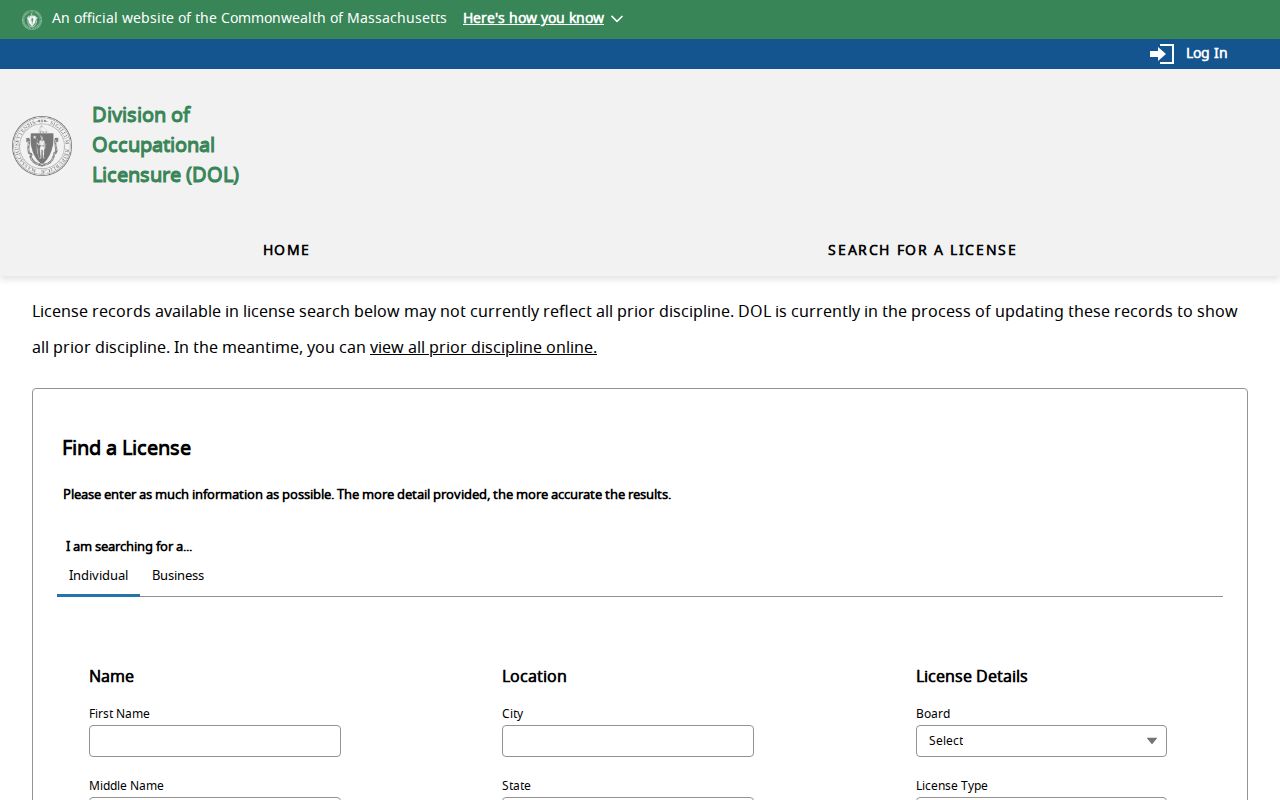
Use less information if an exact search fails, then compare status, license type, board, and access date. A city or ZIP in a license record can be a business or mailing location. Braintree's official Town Resource Directory is useful for finding organizations, historic resources, houses of worship, and town services, but it is not a directory of private households.
Privacy Rules for Braintree Resident Searches
Public access does not remove privacy rules. Massachusetts protects central-registry voter names and addresses from general disclosure. Certain vital records, motor-vehicle data, sealed court material, juvenile information, and criminal-record information have separate limits. The Address Confidentiality Program lets qualifying survivors and certain protected-care providers use a substitute address in public records. An older deed, newspaper, or directory can predate that protection. Do not republish a sensitive address simply because an older record contains one.
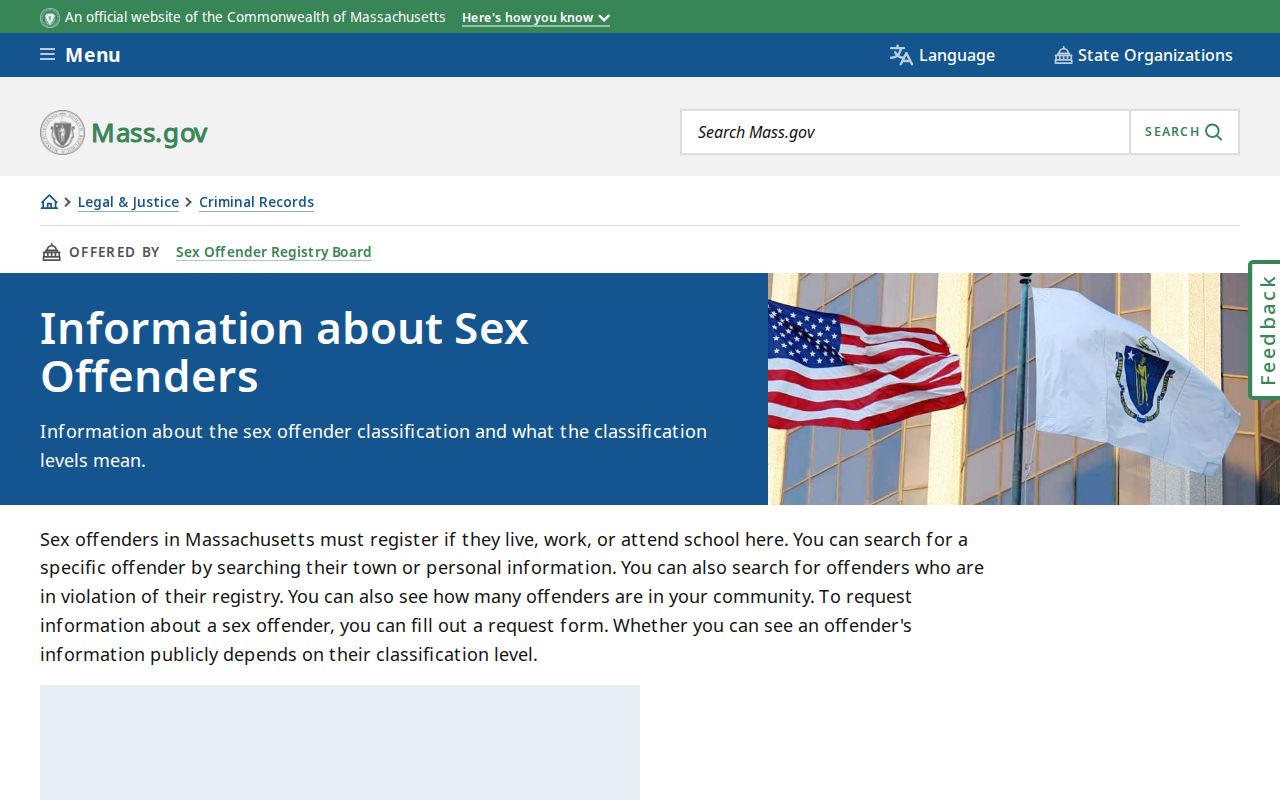
The Sex Offender Registry Board information page is another example of an official system with deliberately limited public access. It restricts public classification information and warns against crime, harassment, and illegal discrimination.
Use only the minimum information needed to follow an official route. Do not collect full dates of birth, Social Security numbers, personal phone numbers, email addresses, signatures, or protected addresses. M.G.L. c. 265, §§ 43 and 43A prohibit stalking and criminal harassment. When a record involves an immediate safety issue, contact law enforcement or a qualified advocate instead of confronting someone.
When Braintree's Official Search Ends
Some gaps are part of the answer. No public searchable Norfolk County jail roster was located. No public historical Braintree permit-search interface was identified. The official channels are the Norfolk County Sheriff's contact or a narrow records request, the Building Division for a dated address or project record, Thayer for local newspapers, and the Town Clerk for a street-list year. An official search may also be incomplete because a record is sealed, restricted, held by another department, or indexed with a different spelling.
Make a request specific. Under Massachusetts Public Records Law, M.G.L. c. 66, § 10, a written request may name the Braintree department, record type, street address or parcel, and date range, then ask for electronic copies and an estimate before fees. The agency generally issues an initial response within 10 business days. If material is withheld, ask for the stated exemption and any reasonably segregable nonexempt material. That route is more useful and more accurate than a broad request for every record about a person.